
 info@indiafashionicon.com
 Vishal Khairnar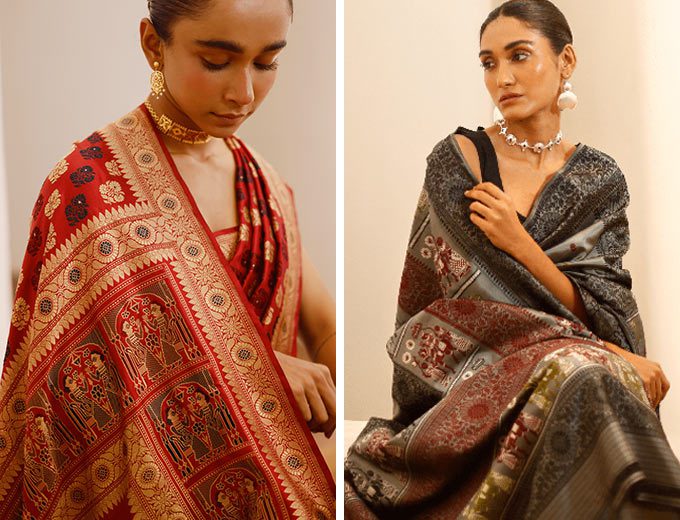
 इस खबर को सुनने के लिये प्ले बटन को दबाएं।


Baluchari: Bengal’s Lost Narrative Textile and Its Enduring Legacy
The Baluchari sari, once the crown jewel of Bengal’s textile heritage, stands as a testament to India’s rich weaving traditions. One of the last celebrated master weavers of the Baluchar tradition, Dubraj Das, created intricately detailed saris featuring paisleys, florals, and figurative motifs, each signed with his distinctive ‘autograph’—a rarity in ancient textiles. Such was the artistic sophistication that patrons and weavers alike considered these saris works of art.
Originating in Baluchar, Murshidabad, the famed Baluchari butidar is often regarded as medieval South Asia’s only narrative silk sari. Its luminous mulberry silk depicted scenes of hookah-smoking nawabs, falcon-holding aristocrats, and courtesans with musical instruments. European sahibs and memsahibs riding elephants, steamboats, and trains were intertwined with traditional paisleys and florals, all presented on long, elaborately woven pallus or anchals. Remarkably, these masterpieces were woven without the use of zari, relying solely on natural dyes.
Today, the Baluchari’s idiosyncratic motifs and quirky human figures survive mainly in museum collections, archives, and connoisseur collections. Darshan Mekani Shah, Project Director and Founder of Weavers Studio, Kolkata, curated exhibitions such as Baluchari: Bengal and Beyond (2016) and Textiles from Bengal: A Shared Legacy (2025), showcasing rare pieces and highlighting their pictorial heritage. Mekani Shah describes the Baluchari as “Bengal’s lost chance at having its own bridal sari.”
The Vanishing Craft and Lost Heritage
The story of Baluchari is inseparable from the river Bhagirathi, believed to have submerged the village of Baluchar. Mekani Shah explains: “We lost not just the place, but also the visual language of the craft—the iconography, the jaala looms, the graphs. When master weaver Dubraj Das passed away in 1903, it is widely believed that the original Baluchar tradition died with him.”
When the Baluchari resurfaced in Bishnupur, the jaala or naqsha loom had been replaced by the jacquard loom, and the iconography was inevitably altered. Drawing inspiration from the terracotta panels of Bishnupur temples depicting the Mahabharata and Ramayana, modern weavers adapted these stories into cloth. Yet, according to Mekani Shah, the contemporary Baluchari is a far cry from the original 18th–19th century masterpieces, lacking the intricacy, finesse, and historical richness of its predecessor.
While much of Baluchari’s legacy today survives in curated collections, the story of Dubraj Das and his iconic saris remains a poignant reminder of Bengal’s once unparalleled textile narrative—a heritage that modern India continues to celebrate, study, and reinterpret.
For more style updates & exclusive fashion stories follow indiafashionicon.com
 Publisher